
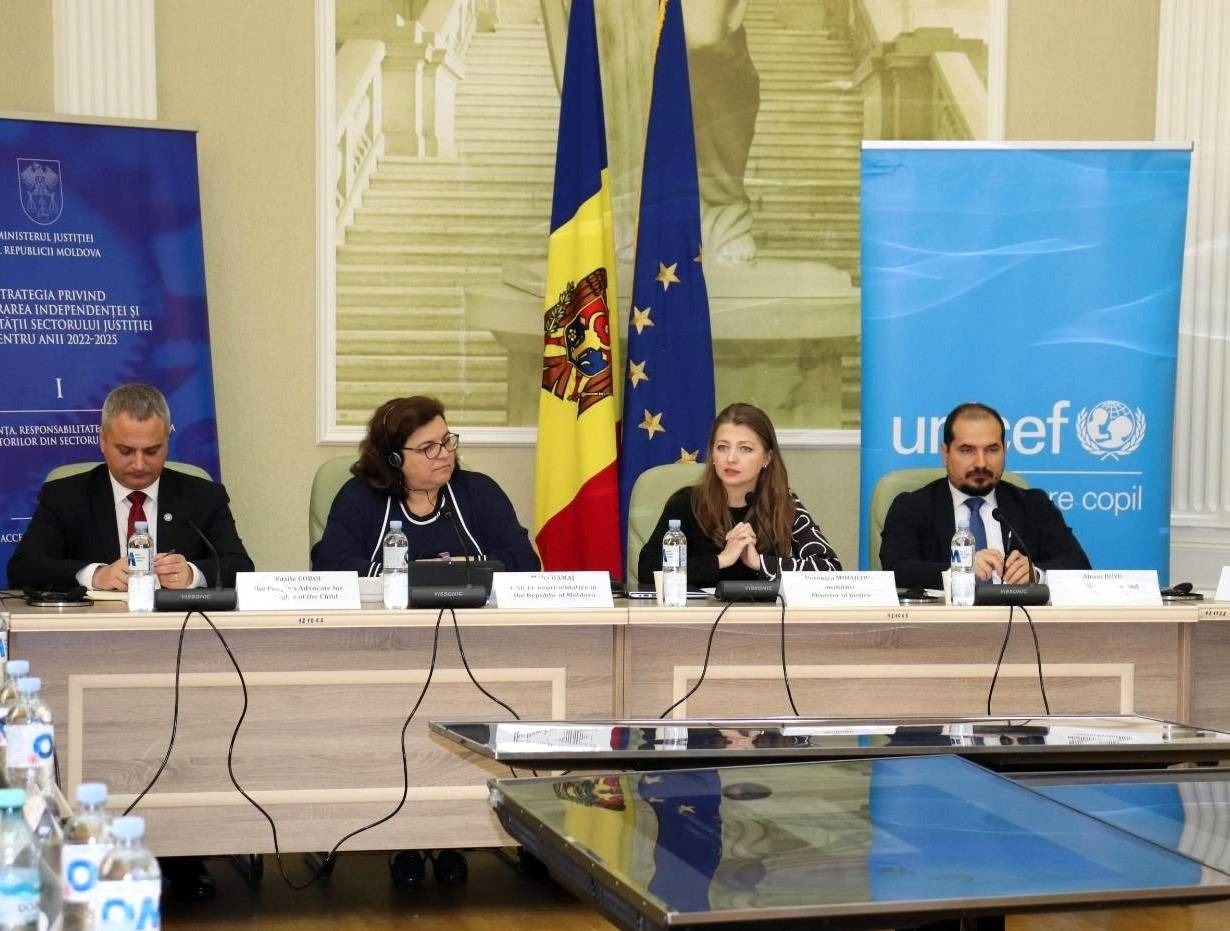
The Ministry of Justice organized the round table with the theme “Child-friendly justice: challenges and needs”
October 31, 2023, Chisinau – In order to ensure the respect of the rights of all children, state institutions must join their efforts to act in a coordinated and continuous manner. This is the conclusion of the round table entitled “Child-friendly justice: challenges and needs”, organized by the Ministry of Justice, in partnership with the United Nations Children’s Fund (UNICEF).
The event served as a platform for discussions between the authorities and development partners regarding the progress made in recent years in the area of juvenile justice, the challenges faced by the state authorities and the identification of the needs that must be covered.
The topics discussed covered the following aspects:
- the retrospective of the legislation in the segment of child victims or witnesses of crimes, as well as specialized services and programs for child victims or witnesses of crimes;
- the restorative justice system and programs for children in conflict with the law and children in detention;
- specialized programs and services for children in conflict with the law under the minimum age of criminal responsibility;
- implementation of the intersectoral child protection mechanism, which ensures effective coordination between institutions.
The Minister of Justice, Veronica Mihailov-Moraru, mentioned the need for an integrated approach and the importance of coordinating the efforts of all state institutions in this field.
“Today, fewer children are convicted or imprisoned. However, when it comes to children, be they victims, witnesses or minors in conflict with the law, respecting the principle of the best interest of the child must be a priority for all actors involved in the process, from start to finish. For these reasons, it is important to combine our efforts in an organized and visible way, to establish effective programs and integrated mechanisms of action to avoid their revictimization, but also to reduce their recidivism”, said the Minister of Justice.
The representative of UNICEF in the Republic of Moldova, Maha Damaj, reiterated UNICEF’s commitment to support the authorities of the Republic of Moldova in the process of adaptation and the creation of a justice system that is friendly to children, where respect for their rights is guaranteed.
“Children go quite a long way before they end up in the justice system – they have been witnesses or victims of sexual or domestic violence for a while, they have been neglected and abused, deprived of parental care and love. The child who ends up in the justice system is fragile, vulnerable, needs care and deserves it,” said Maha Damaj.
For their part, the state secretaries of the Ministry of Justice, Stanislav Copețchi and Nadejda Burciu, spoke about the evolution of the legislation aimed at the protection of children, but also the correctional programs and the assistance given to minors, depending on their needs.
The hearing of children in special conditions was mentioned as an example of good practice. This mechanism avoids the revictimization of children in vulnerable situations and provides the opportunity for minors to interact with qualified specialists.
In this context, the necessity of multiplying the specialized integrated assistance centers for child victims or witnesses of crimes, which offer professional psychological, legal, medical and social support, was found. At the same time, the existing spaces in the courts and prosecutor’s offices, intended for the hearing of minors under special conditions, must be improved and used to the maximum.
However, the biggest challenge stated by the participants in the event is the lack of qualified staff to provide services for children at all levels (preventive, social, correctional). In this context, the need to hire and train more specialists was discussed.
It was also discussed the need to increase the number of interviewers, experts, psychologists, the development of more services and programs for children in conflict with the law, their participation in decision-making and, last but not least, the monitoring and evaluation of interventions.
Following the interventions of the Minister of Labor and Social Protection, Alexei Buzu, the State Secretary of the Ministry of Internal Affairs, Daniella Misail-Nichitin, the Ombudsman for Children’s Rights, Vasile Coroi, and also the representative of the Ministry of Education, it was scored, as desired, the need to ensure the traceability of case management and the monitoring of each child when he moves from one institution to another. Only as a result of the strengthening of institutional cooperation and the individual approach to each child, we can ensure the correction of deviant behavior and the social reintegration of minors in conflict with the law.
The event was organized in partnership with UNICEF and with the support of the Ministry for Economic Cooperation and Development (BMZ) of the Federal Republic of Germany through the German Development Bank (KfW). It gathered at the discussion table decision-makers from several state institutions: the Ministry of Justice, the Ministry of Labor and Social Protection, the Ministry of Internal Affairs, the Ministry of Education and Research, the Office of the People’s Advocate, the General Prosecutor’s Office, the National Administration of Penitentiaries and the National Inspectorate of Probation.


